This is IOT,Big-Data related blog and news for
Future Technology: Artificial Intelligence, Robotics, IoT and Big Data
Augmented reality, Cryptocurrency, Exocortex, Machine vision, Quantum computing, Speech recognition, Virtual Reality
Note: This is a blog for future upcomming most important technology like IOT(Internet of things),Big data and Robot technology
It is often said, people do not buy product or services, but they do buy relations, stories and magic. That’s where the storytellers and influencers come in. Whenever something new, disruptive gets launched, there is always a bit of skepticism which hovers around it. Influencers are the frontrunners who lead the people’s imagination and curate their curiosity and do what they do the best – influence them.
“To be an influencer, you have to love people before you can try to lead them.” – John C. Maxwell
Stacey Higginbotham: A former writer for GigaOm and Fortune, Stacey is the founder of The Internet of Things Podcast, manages a weekly IoT newsletter and writes for The Wirecutter and PC Mag.She is one of the most prominent writers to look for irrespective of beginner or expert in the domain.
Jenny Fielding:
Jenny leads both the FinTech and Internet of Things accelerators. She is a keen investor and has been one of the most sought-after speaker in IoT domain.
Daniel Herscovici: Daniel is a general manager and senior vice president of Xfinity Home, Comcast's highly successful Smart Home platform which provides subscribers with a simplified yet elegant user experience.
Kristine Faulkner:
She is at the helm at leading Cox's Smart Home efforts and contributes to the growth of the growth of that business unit. She is a leader to follow as curated solutions begin to drive mass-consumer adoption. She is also one of the leading speakers in the tech conferences.
Elizabeth Mathes: She leads the IoT division of Home Depot. She's helped creating one of the most fascinating consumer offerings for smart home products and is helping raise awareness in the consumer markets.
Scott Harkins:
Scott Harkins is Vice President of Partner Development within Honeywell's Connected Home & Building organizations. He is behind the success for Honeywell's home security channel and to make Honeywell as the security leader in IoT.
Sarah Cooper: She is one of the frontrunner to Amazon's remarkable growth and success in IoT as GM of IoT solutions at Amazon Web Services. She is also at the helm of Vice-chair of the IoT Community.
Beth Comstock:
Beth Comstock has garnered her reputation in the Tech industry. She is responsible for GE's efforts to accelerate new growth, and she will lead the IoT initiative of GE from the front.
Jim Hunter:
Jim is the Chief Scientist and Technology Evangelist of Greenwave Systems, where he has oversight of technology, architecture, and innovation of the Axon platform. Jim has been a successful entrepreneur.
Matt Eyring:
Matt is a one of the phenomenal speaker to follow in IoT. He has impressively helped Vivint shift as a leader in smart home security in the dealer channel. He has got his reputation for challenging the established status quo and trying to innovate.
Charlie Kindel:
Kindel is the man behind the The Amazon Echo and Alexa voice assistant which were the first massive consumer hits in the Smart Home. By focusing on voice as the user interface, Kindel and Amazon have redefined how consumers engage their everyday lives.
Andrew Thomas:
Andrew pegged the deal and led from the forefront the SkyBell's $600,000 Indiegogo campaign in 2013, and has helped scale SkyBell by landing significant deals with big companies in the space. Andrew is an active IoT speaker, social influencer, and advisor.
Greg Kahn:
Greg Kahn is known for his smart and analytical mindset, his continuing and everlasting enthusiasm and activity in the IoT community. In his role as president and CEO of the Internet of Things Consortium he has been leading the growth of IoT community from the front.
Nate Williams:
He was CMO of 4Home, and was CRO at August Home. Nate is an active speaker, investor and advisor in IoT, where he advises and takes active part in investments in Roost, Matterport and Datascience.
Sridhar Solur:
He is driving innovation and product strategy for the Xfinity Home business for Comcast. He is known for his fascinating and mesmerizing speech and tremendous knowledge in IoT.
Michael Wolf:
He is the founder and chief analyst of NextMarket Insights, and host of the Smart Home Show - a top podcast in IoT.
Rob Martens:
He is currently serving as Schlage's Futurist and Vice President of Strategy & Partnerships. Rob is known for curating interesting and relevant content on IoT and shares his vision on stages.
Marwan Fawaz:
Marwan is CEO of Nest Labs and has taken the responsibility to take the company back to its previous reputation as a top inventor and innovator of smart products and services.
Mark Spates:
Mark is the apple’s eye for IoT innovation. He is currently leading the product development part of Google. He is the founder of Iotlist.co and formerly the Head of Connected Home Platform at Logitech.
Brenna Berman:
Chicago has made its mark in the history again for this lady. As acting Chief Information Officer of Chicago, Brenna is leading the city from the front to make it the example of IoT smart city in the world.
Quick quiz: what do you visualize when you hear the word robot? Some machine in human form, behaving like a human? Or perhaps one of the massive, spiderlike machines that assemble complex products ranging from automobiles to computers?
In reality, modern robotics follows both paths. However, in spite of the progress with humanlike robots, most business applications of the technology focus on machine forms that are specific to the task at hand, whether it be a Mars Rover or a medical robot assisting a surgeon.
There are exceptions to this rule, however: companies who focus on making robots as humanlike as possible, with the eventual goal of behavior so realistic it can actually fool people into thinking the machine is fully human.
To achieve such levels of verisimilitude, such robots must have sophisticated artificial intelligence (AI) built in. For example, take Sophia, the creation of Hanson Robotics that Saudi Arabia recently granted citizenship to, in a lavish publicity stunt.
Sophia has the ability to carry on limited conversations, requiring AI-driven natural language processing. ‘She’ can also recognize faces and respond to interactions emotionally, both via tone of voice as well as through a complex set of facial expressions – all technologies that depend upon AI.
In many ways, however, Sophia is less about AI and more about theatrics. ‘Her’ creators have combined AI, robotics, and elements of show business to prove that a fake person can be sufficiently realistic to be appealing rather than repulsive. Not In Our Digital House
What they have not accomplished – and in fact, aren’t attempting to accomplish – is to create AI that can simulate human behavior in a way that solves true business problems.
Sophia the Robot at Web Summit 2017STEPHEN MCCARTHY/WEB SUMMIT.
What Do We Really Want from Human-Like AI?
In spite of decades of Hollywood influence, the real money in robotics today is in the massive armlike devices from industry. No witty banter, no subtle smiles here – instead, these machines focus on the tasks at hand.
When we talk about AI, however, we’re on shakier ground, as most of today’s applications of AI in business are not particularly humanlike. True, we have voice interactions like Siri, image recognition, and machine learning-driven predictions based upon crunching massive quantities of data – but if you think about it, these capabilities are only vaguely humanlike at best.
On the other hand, Artificial General Intelligence (AGI) – that is, true humanlike reasoning ability – is still well out of reach today. In the absence of AGI, then, what are the most advanced AI capabilities we can currently bring to bear to solve real business problems?
I recently spoke with Donald Thompson, Founder and CTO of AI-driven knowledge platform vendor Maana, to get his take on this question. “Maana supports decision making, reasoning, and answering questions,” Thompson explained. “We construct models that represent human expertise and combine them with data models in the context of optimizing a decision flow or equipment like an oil well.”
Where Sophia is able to mimic human expressions and conversations, Maana’s ability to mimic – or perhaps duplicate – human expertise provides the business value context that Sophia’s theatrics cannot.
The essence of Maana’s technology is what Thompson calls ‘digital knowledge.’ “Digital knowledge consists of models of the domain of business artifacts with the business goal in mind. These models digitize decision flows, and provide recommendations that help experts in the organization make better and faster decisions,” he explained.
The business artifacts in question could represent a wide variety of different types of information, from PDF documents to spreadsheets to emails to sensor data to information bottled up in various applications. From these artifacts, Maana is able to create data models, as well as computational models that mathematically model the human knowledge of a specific business process.
Given the rather philosophical questions about the nature of human knowledge, Maana puts a fine point on this conundrum. “We phrase every knowledge model as an answer to a business question,” Thompson said. “These are higher order questions, for example, ‘given the pump failure in a particular oil well, what are other oil wells with similar pumps?’”
The choice of oil wells in this example is no accident: Maana has found traction in the petroleum industry, listing companies such as Chevron CVX +0.66% Corporation, Royal Dutch Shell , and Saudi Aramco as customers as well as investors.
The reason that the oil business has taken to Maana’s AI-driven decision-making capability is due to the combination of the industry’s massive big data sets with its ability to distil its business goals into easily digested statements.
Thompson clarified the types of goals Maana’s technology targets. “The goals include minimization (for example, risks or costs) or maximization (for example, profits),” he said. “For example, given this list of constraints, what risks should we mitigate?”
In fact, Maana’s ability to interpret constraints gives the technology a leg up on modeling human expertise, as such expertise often boils down to dealing with constraints on a day-to-day basis.
For example, a person may know how to accomplish a goal, but also must know about all the various exceptions that might occur and how to deal with them. Such exceptions are a type of constraint.
Knowledge modeling in order to achieve certain goals can be thought of as decision support. “By decision support we mean that the technology can observe a particular domain, reason about the domain, justify and explain its reasoning, and then allow the user to hypothesize about different courses of action.”
The latter point is especially important: the technology does not generally make business decisions itself, but rather supports human decision making – in part by empowering people to simulate the results of different actions they may take.
Such decision support requires a mix of technical capabilities. “It’s a combination of natural language processing, constraint satisfaction, and simulation,” Thompson explained. “Maana adds constraint satisfaction and Bayesian probabilistic inference.”
The result is human-like reasoning, as different from simpler forms of AI like machine learning as the auto assembly robot is from Sophia. “Contrast Maana’s approach with machine learning, which is how to train machines to learn from data,” Thompson said. “Reasoning is the ability to answer a question.”
As with every vendor in the emerging AI marketplace, Maana’s technology will continue to improve over time. However, its ability to model human expertise to answer business questions in order to support mission-critical decisions gives the technology human-like characteristics that provide business value that other technologies cannot, the gimmicks and other theatrics of Sophia notwithstanding.
Intellyx publishes the Agile Digital Transformation Roadmap poster, advises companies on their digital transformation initiatives, and helps vendors communicate their agility stories. As of the time of writing, Maana is an Intellyx customer. None of the other organizations mentioned in this article are Intellyx customers. Image credit: Stephen McCarthy/Web Summit.
Jason Bloomberg is president of industry analyst firm Intellyx.
Jason Bloomberg is a leading IT industry analyst, Forbes contributor, keynote speaker, and globally recognized expert on multiple disruptive trends in enterprise technology and digital transformation. He is founder and president of Agile Digital Transformation analy...
“Blockchainisation” is underway and here are 5 areas that will most like
be deeply affected by the technology.
We’re sure you’ve heard a lot about Blockchain and Bitcoin (check out this insane infographic for some cool, easy-to-digest facts).
But what makes Blockchain so special?
Here’s a quick overview:
1. Blockchain is Decentralized:
Blockchain runs on a global network of users’ computers. Each member contributes processing power to the whole, and the network doesn’t function properly without a constant influx of new miners.
2. It’s Public:
On Blockchain, everyone can see everything all the time–it’s 100% transparent.
3. It’s Encrypted:
Blockchain uses robust encryption to maintain virtual security. Aside from a strong external defense, there is no central database to hack in the first place.
5 ways the world will change thanks to #Blockchain technology
Throughout the day and every couple of minutes, Blockchain transactions, which are initiated by complex math problems that computers work together to solve, are checked, erased and stored in a block that is linked to the previous block, creating a chain, hence the name “Blockchain”.
This structure prevents any one user from modifying historical data.
If someone, for example, wants to modify data (say, to steal a Bitcoin), they’ll have to rewrite, in real-time, the entire Blockchain record–which is virtually impossible.
This is one of the things that makes Blockchain one of the most promising networking and currency technologies. If you consider how it can be combined with the latest advances in AI and the IoT, we are poised to change the world.
5 Ways Blockchain Will Change the World:
1. Taxes
Taxes are collected and then delivered to local governments or the state following a complex audit system that costs a lot of money and time to carry out.
Governments can use Blockchain technology to implement, track and receive taxes in real time. Blockchain may help streamline and even eliminate taxes as we know them–but that’s certainly further off.
In the meantime, start-ups are developing innovative solutions toward this direction.
For instance, Chainalysis, a company specialized in analyzing the Bitcoin Blockchain, is helping some clients, including the IRS and Europol, to identify Bitcoin tax cheaters.
2. Digital ID
United Nations stats show that globally over one 1 billion people cannot provide documented proof of their existence, which raises many social, cultural and political challenges.
ID2020is a global public-private initiative that seeks to remedy this situation. Microsoft and Accenture, at the last ID2020 summit held last June in New York, presented a prototype digital identification system based on Blockchain protocols.
Estonia issues e-residency cards for its residents, based on Blockchain technology. India also aims to use the technology to enhance the Aadhar registry.
3. Digital Advertising
Blockchain can solve many issues now inherent to digital advertising, such as those that come along with fraud and transparency.
The market of peer-to-peer advertising via Blockchain is taking shape.
Created by MetaX and DMA, adChainis an open protocol built on the Ethereum Blockchain.
adChain ensures that ad spending reaches where it needs to without going through a complicated ad supply chain, without fake views, and it favors efficiency, trust, and transparency between advertisers, publishers, and customers.
4. Transparency and Accountability
With tamperproof records, Blockchain protocols can handle more than virtual currency transactions.
Among the areas where Blockchain tech can be applied, there is the storage and exchange of documents, certificates or the setting up of contracts.
Decentralization, autonomy, security, and transparency of accounts are what Blockchain technology can offer to companies.
Blockchain offers a secure e-voting tool whose results are transparent and none can modify them afterward.
5. Smart Digital Assets
Investors could leverage Blockchain as a smart system to track their digital assets. Using the open ledger, they can prove ownership of the asset and track its movement.
In case of physical assets, a digital identity of the item can be recorded in real-time. This should help with physical transactions and shipping from getting items through foreign government customs to shipping items remotely.
For example, Portion is a startup that allows you to easily rent out unused goods, using fraud-resistant “smart-tags” to represent a physical item as a virtual asset and thereby authenticates ownership.
Artificial Intelligence can compose songs, paint pictures, help in cancer therapy, drive cars and play games. It’s also starting to write code.
Does it mean that the days of human developers are already numbered?
When you look at tests of personal assistants such as Siri, Google Assistant or Cortana, you will discover that probably the most frequent request they hear is:
Tell me a joke.
Is that really all that Artificial Intelligence can do for us? Not at all. Its achievements are getting more impressive every day.
So before we tackle the question of Artificial Intelligence replacing software devs, let’s explore the achievements of AI thus far.
What can AI do?
Beat humans in board games and quizzes
In 1997 in New York City, the IBM computer Deep Blue won a chess match against Garry Kasparov. It was the first time when a machine defeated the world chess champion under tournament conditions.
In 2011, another IBM computer - Watson - took part in the television quiz show “Jeopardy” against former winners. Watson had to listen to questions and give answers in natural human language.
He was not connected to the internet.
However, he learned from 200 million pages of structured and unstructured content taking up four terabytes of disk storage. Watson won the first place prize of $1 million.
In March 2016, AlphaGo - a computer programme from Google DeepMind created to play the board game Go - beat Lee Sedol, the World Champion in Go. The man and the machine played a five-game tournament in Seoul. Lee Sedol won only the fourth game. In the rest, the machine proved superior.
Lee Sedol playing against DeepMind - an Artificial Intelligence from Google
Make medical discoveries
AI has already led to breakthroughs in medical diagnostics.
In 2013, Artificial Intelligence was put to work to detect breast cancer. A neural network was trained to find signs of cancer using tens of thousands of mammographic pictures of the disease.
But the neural network has learned that it is not so important to look for the tumors themselves, but rather some other modifications of the tissue which aren’t in the immediate vicinity of the tumor cells.
This was new knowledge to humankind. Until 2013, medicine didn’t know that.
Compose songs
Magenta is a project from the Google Brain team. It tries to answer the question: “Can we use machine learning to create compelling art and music? If so, how? If not, why not?”
The team works using TensorFlow - a machine learning library from Google. Have a listen to Magenta’s first computer-generated song - composed without any human assistance.
Paint pictures
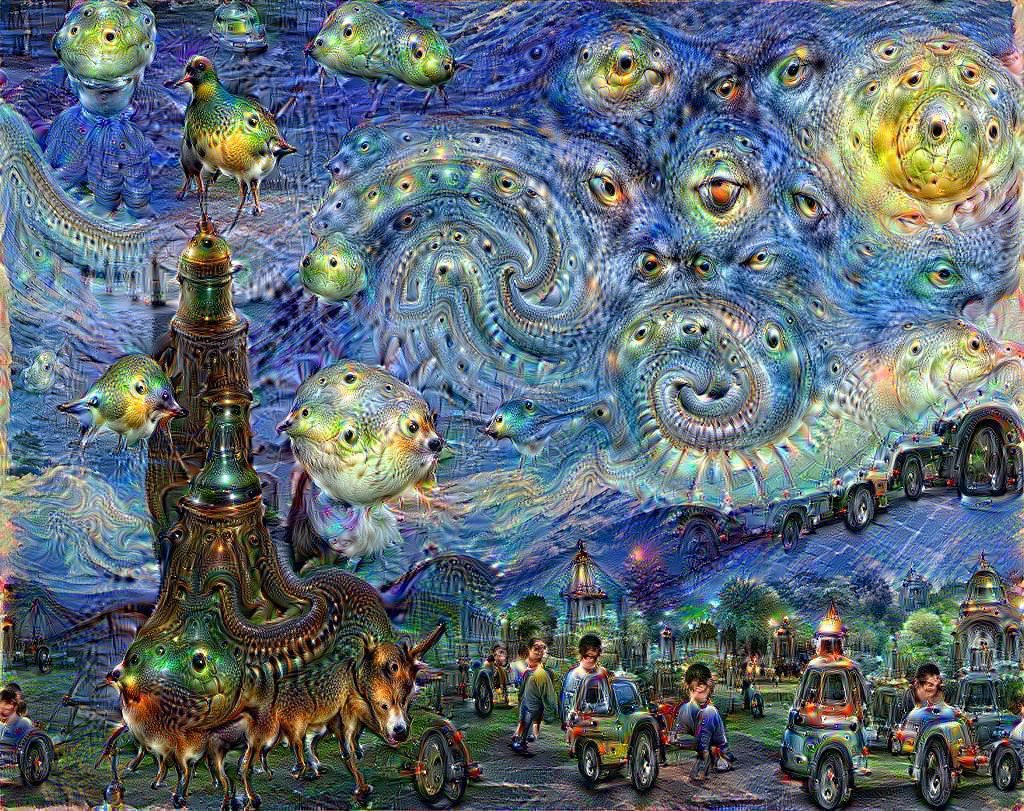
In February 2016 in San Francisco, Google sold 29 paintings on a charity auction. All of them were made by Google’s Artificial Intelligence.
The event was called “DeepDream: The art of neural networks.” The paintings (masterpieces, if you ask me) went for more than 8000$, as The Wall Street Journal reports.
Google Deep Dream painting
And that’s not all AI can do. It can also drive motorways, write poems, and much more.
What it can’t do is write code. Or can it?
AI for everyone
In December 2015, Google released the TensorFlow library to the public. Now it’s an open-source software for machine learning.
Why did Google give out this powerful piece of software for free? According to prof. Christian Bauckhage from Fraunhofer-Institut für Intelligente Analyse- und Informationssysteme, Germany (IAIS), you can find the answer in Google’s history. About 10 years ago, Google has open sourced the Android Operating System for smartphones. 10 years later, 80% of all the smartphones in the world run on Android.
"This is what they are trying to do right now. 10 years from now, the idea is that 80% of AI will run on Google TensorFlow," prof. Bauckhage said at the CeBIT Conference last year.
What happened after Google’s release? A few weeks later Microsoft open-sourced their Computational Network Toolkit AI - a deep learning framework now called the Microsoft Cognitive Toolkit.
After another few weeks, Facebook opened-sourced their own Artificial Intelligence libraries - Caffe2.
AI is writing code
In 2015 Andrej Karpathy, now director of AI at Tesla and a Stanford Computer Science Ph.D. student, used Recurrent Neural Networks to generate code. He took a Linux repository (all the source files and headers files), combined it into one giant document (it was more than 400 MB of code) and trained the RNN with this code.
He left it running for the night. In the morning, he got this:
Sample code generated by Artificial Intelligence
Literally overnight, the AI generated code including functions and function decorations. It had parameters, variables, loops and correct indents. Brackets were opened and later closed. It even had comments.
The AI made some mistakes of course. Sometimes variables were never used. Other times, there were variables which were not declared earlier. But Karpathy was satisfied with the result.
‘The code looks really quite great overall. Of course, I don’t think it compiles but when you scroll through the generate code it feels very much like a giant C code base,’ Karpathy wrote on his blog.
The project is available on GitHub. It uses the Torch7 deep learning library. Here is the whole output file received by Karpathy.
DeepCoder
Microsoft and Cambridge University researchers have developed an Artificial Intelligence that can write code. The AI is called DeepCoder and it has the ability to learn.
DeepCoder can write working code after searching through a huge code database. It tries to make the best possible arrangement for the harvested code fragments and improves its efficiency over time.
This doesn’t mean the AI steals code, or copy-pastes it from existing software, or searches the internet for solutions. The authors of DeepCoder expect that it will be participating programming competitions in the near future .
Example programme in Domain Specific Language (DSL) created by DeepCoder
According to Marc Brockschmidt of Microsoft Research, who is a part of the project, such system could be of great utility to non-coders. They only have to describe their program idea and wait for the system to create it.
‘We might end up having such system in the next few years. But for now, DeepCoder’s capabilities are limited to programs consisting of five lines of code,’ he said.
Since this is a primarily Python-focused blog, we would be remiss if we didn’t give you at least one Python example.
In June 2016, a French engineer by the nickname of BenjaminTD published a blog post in which he explained how he was “teaching an AI to write Python code with Python code”.
He used Long Short Term Memory (LSTM) - one of the most popular architectures of recurrent neural networks. He fed it with lots of Python code (using libraries such as Pandas, Numpy, Scipy, Django, Scikit-Learn, PyBrain, Lasagne, Rasterio). The combined file weighed 27MB.
The AI then generated its own code. It was defining inits:
...using boolean expressions:
...and creating arrays:
If you look at the arrays carefully, you will find a syntax error. Benjamin’s code is far from perfect. But the engineer thinks that it’s not bad for a network that had to learn everything from reading example code.
‘Especially considering that it is only trying to guess what is coming next character by character,’ he concludes his blog post.
Will AI replace programmers?
The Hollywood fiction of AI supplanting humans hasn’t come true yet. We are far from a 2001: A Space Odyssey scenarios of a rogue AI turning against its human masters and killing off space crews.
That does not stop filmmakers from generously employing the theme of AI rebellion in their works.
But can we be so sure that real-life AI can be controlled?
In 2016, Microsoft released a Twitter bot - Tay. It was designed to mimic the language patterns of a 19-year-old American girl, and to learn from interacting with human users of Twitter. After just 16 hours following its launch, Microsoft was forced to shut Tay down because the bot began to post offensive tweets.
That’s not the only AI issue on record. In early 2017, Facebook had to shut down its bots - Bob and Alice. They were created to perform conversations between human and computer. But when the bots were directed to talk with each other, they started to communicate in a way that was impossible for people to understand.
A few months later a Chinese chatbot - Baby Q - was switched off after it started to criticize the Chinese Communist Party. Baby Q called it "a corrupt and incompetent political regime".
So, is AI a threat or an opportunity? Elon Musk is known for his scepticism towards AI. His worry is what will happen when the machine becomes smarter than the human.
"Even in the benign scenario, if AI is much smarter than a person, what do we do? What job do we have?’" he asks.
There is no doubt that computers will be much better at programming in the near future than they are now. Which brings us to a quite scary conclusion.
"It’s just a matter of time until neural networks will produce useful code. So things are looking bleak for computer scientists like me" prof. Bauckhage believes.
But is the future really that dark? According to Armando Solar-Lezama of MIT, tools like DeepCoder do have the potential to automate code development, but AI isn’t going to take away the jobs of developers. Instead, a system based on program synthesis can be used to automate the tedious parts of code development while the developers focus on complex tasks.
There are already startups using automation to build ‘smart software’. Dev9 is a custom software development company based in Seattle focused on Java and JavaScript. Dev9 assembles teams that use artificial intelligence to develop custom software, eliminating strenuous processes and drastically reducing manual overhead. Will Iverson, its Chief Technology Officer, was asked if programmers need to be worried about being replaced by AI in the near future, and replied:
Eventually, yes. But by that point, society will be very used to dealing with that kind of societal change. The millions of paid drivers replaced by self-driving cars will have long since forced our political and economic systems to figure out how to deal with these transitions. We have joked around the office that software development will be one of the last professions left.
Will Iverson, CTO at Dev9
Regardless of whether our worries are justified, the fact is that nearly a third of software developers fear that artificial intelligence will eventually take their jobs. In an Evans Data Corp.survey, 550 software programmers were asked about the most worrisome thing in their careers. The most common response (29%) was:
"I and my development efforts are replaced by artificial intelligence."
According to Janel Garvin, CEO of Evans Data, the thought of obsolescence due to A.I., "was also more threatening than becoming old without a pension, being stifled at work by bad management, or by seeing their skills and tools become irrelevant."
There is no doubt that AI technology will developing and grow smarter. Eventually it will become smarter than humans. How can we handle such a possibility? Stephen Hawking also sees a real danger that computers will develop intelligence. But he also offers advice:
"We urgently need to develop direct connections to the brain so that computers can add to human intelligence rather than be in opposition," Hawking says.
For many Internet of Things observers, the IoT’s dizzying embracing and subsequent reshaping of modern business and cultural standards seems like it happened only yesterday. Yet the IoT is moving ever faster, developing at an astonishing rate and continuously reinventing itself. So what’s the next step in the long-line of IoT innovation, and how can eager investors cash in on tomorrow’s IoT fad today?
Those used to the ever-changing nature of the IoT will know by now that it’s constantly changing, but will also be aware that innovation in certain areas matters much more than gradual developments elsewhere. A quick review of the 4 things reshaping the IoT’s future the most shows which industries will be most vital towards its development and offers an alluring glance of what the IoT of tomorrow will look like:
1. An explosion of sensors
Few things empower the IoT as much as the sensors which make up its physical senses in the real world; already, millions of embedded sensors help companies and individuals collect useful data about the world around them, so that they may in turn shape it with better business decisions or new products. The IoT sensor market alone is expected to be worth a staggering $27 billion by 2022, and the rapid growth of an industry supplying the physical sensors and the coding that powers them will only continue in the coming decades.
As billions of global consumers become the proud owners of smartphones and other handheld gadgets, the sensors which make up the IoT will not only grow in quantity, but also in financial value. As refinements to sensory technology continues, IoT-connected devices will be able to collect more data in less time at cheaper rates, and they’ll be able to better store, sort, sell, and make use of that data in the marketplace.
2. A new regulatory environment
Even strangers and newcomers to the IoT often recognize that consumer privacy and market regulation are two of the biggest concerns of the world’s largest digital phenomenon. Growing rates of corporate data breaches, such as the Equifax fiasco that jeopardized the personal data of millions of Americans alone, are making consumers and regulators alike more interested in data privacy and the general regulation of the IoT.
This will have a sizable impact on gadget producers and software developers alike; tomorrow’s IoT products and services will be created in a significantly stricter business environment, and greater cost will be shouldered by companies when it comes to things like investing in necessary IT security infrastructure and gadget security, not to mention data management.
3. Machine learning comes into its own
Anybody keeping tabs on the IoT has undoubtedly heard about machine learning and the wonders it can work in the business world, but fewer people understand that machine learning and the use of algorithms in tandem with the IoT in general are merely in their infancy. Much in the same way that today’s standard IoT devices and logo design software would look alien to someone only 10 years ago, the IoT of the next decade will be all but unrecognizable.
Top companies like Google, Microsoft, and IBM are all pouring money into artificial intelligence and machine learning for good reasons; current applications of algorithms in the business world are only the tip of the iceberg. Tomorrow’s IoT will be shaped largely by those with control over the best data-analytics and machine learning capabilities, which will be needed to keep up with the ever-increasing deluge of data and devices that stems from the IoT’s continuous expansion.
4. Better security & physical standards
The high levels of attention being paid to IoT security in light of continuous hacks and data breaches will have a strong impact in the long term; in the IoT of tomorrow, gadgets won’t be valued based on how cheap they are to produce and program, like they are now, but rather based on their levels of security and physical endurance.
Advancements in everything from IT security infrastructure to gadget batteries and production standards will reshape current marketing trends and consumer patterns. Devices will be able to operate longer without needing a charge, and data privacy standards inside of IoT companies will themselves be much more stringent to prevent outside regulation or intrusion.
Ultimately, a public reevaluation of security standards is likely to drive the physical world of the IoT as much as it is the regulatory world that exist on paper to constrain it. The only consistent thing about the IoT is that it’s constantly evolving, surpassing modern expectations and standards and demanding new innovations and perspectives to adapt and conquer new sectors of the market. Much of the IoT of the 21st century will look completely different, but investors and consumers alike are unlikely to see more change than in these key 4 areas.